Part 3: Learning Sequence for Teacher and Student User
Overview and Structure
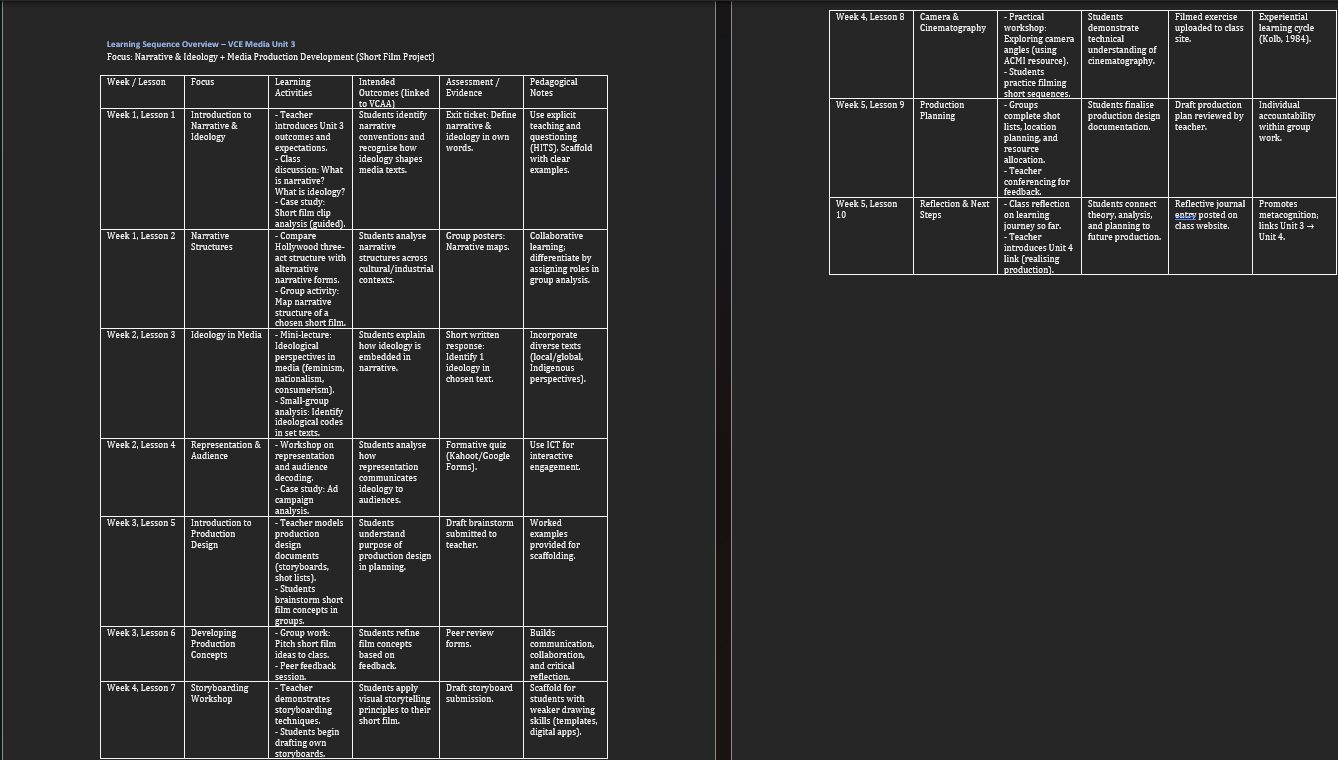
The sequence spans six weeks, assuming three 70-minute sessions per week, in alignment with VCE Media Unit 3 expectations. It is deliberately structured to integrate critical analysis (Area of Study 1: Narrative and Ideology) with production development (Area of Study 2: Media Production Development). This dual focus ensures that students not only engage with theoretical perspectives but also apply their knowledge in the development of a practical project, laying the foundation for their Unit 4 production.
The design adopts a progressive, scaffolded approach, beginning with guided analysis of narrative and ideological frameworks and gradually moving toward independent application in short film production planning. Early lessons emphasise explicit teaching (Rosenshine, 2012) of key concepts such as narrative structures, codes and conventions, representation, and ideology. These are reinforced through case study analysis, collaborative tasks, and class discussions that allow students to link conceptual understanding to real-world examples. By mid-sequence, the emphasis shifts to hands-on production development, where students create and refine their own production design documents, including treatments, storyboards, and shot lists.
The sequence is designed with both teacher-users and student-users in mind. For teachers, each lesson includes clear intentions, explicit connections to VCAA outcomes, and suggested High Impact Teaching Strategies (HITS) to guide delivery. This ensures alignment with curriculum requirements and best practice pedagogy. For students, tasks are presented as accessible, step-by-step activities with prompts, scaffolds, and digital resources (e.g., ACMI’s Exploring Camera Angles, Canva storyboard templates, and StudioBinder tutorials). This dual design makes the sequence both practical and replicable.
Each week of the sequence follows a deliberate rhythm:
Introduction of key concepts through explicit teaching, worked examples, and guided questioning.
Collaborative exploration through group tasks, peer discussion, or text analysis.
Practical application via production planning, creative exercises, or digital tool use.
Reflection and consolidation through exit tickets, journals, or feedback cycles.
This rhythm ensures that learning remains cumulative, with students consistently revisiting and applying prior knowledge in new contexts. Formative assessment is embedded throughout via peer review, teacher feedback, and reflective journals ensuring students track their own progress and refine their work before summative assessments.
Importantly, the sequence is underpinned by a commitment to equity and differentiation. Teachers are encouraged to provide text options and scaffolded templates for students requiring additional support, while extension activities (such as independent research into industry practice) are available for advanced learners. Group work is structured to value diverse contributions, with students able to adopt roles that reflect their strengths and learning goals.
By integrating critical analysis with creative production, this sequence mirrors the professional practice of media makers, who must understand both the “why” of meaning-making and the “how” of production. It also positions students as active participants in their learning, fostering autonomy, collaboration, and critical reflection. Ultimately, the structure supports students in building the analytical and creative skills necessary for both academic success in VCE Media and lifelong engagement as informed media participants.
Week 1: Introduction to Narrative and Ideology
Teacher focus: Introduce narrative conventions, institutional contexts, and ideology. Model close analysis of a chosen film (e.g., The Hunger Games or Parasite).
Student tasks:
Watch selected clips.
Identify codes and conventions.
Discuss how power, values, and cultural assumptions are represented.
Homework: Reflective blog post on ideological positioning of audiences.
Pedagogical strategies: HITS #2 (Structuring lessons), HITS #4 (Questioning), Bloom’s Taxonomy (from comprehension to analysis).
Week 2: Comparative Case Studies
Teacher focus: Introduce Australian and international texts. Guide comparative analysis of ideological frameworks (e.g., Mad Max: Fury Road vs. Black Panther).
Student tasks:
Group analysis of representation (gender, race, class).
Present findings using Padlet.
Homework: Short essay draft (SAC preparation).
Pedagogical strategies: HITS #6 (Multiple exposures), peer collaboration (Vygotsky, 1978).
Week 3: From Analysis to Production Concepts
Teacher focus: Transition into production development. Scaffold links between ideology in media texts and students’ own creative intentions.
Student tasks:
Brainstorm short film concepts that embed ideological messages.
Draft concept statements.
Peer review and feedback session (Google Docs).
Pedagogical strategies: HITS #8 (Feedback), Kolb’s experiential cycle.
Week 4: Production Planning
Teacher focus: Guide students through production planning — storyboards, shot lists, scripts. Model how planning reflects both creative choices and ideological intention.
Student tasks:
Develop pre-production documents.
Workshop script excerpts in groups.
Pedagogical strategies: HITS #5 (Collaborative learning), Bloom’s higher-order skills (creation, evaluation).
Week 5: Refinement and Pre-Production
Teacher focus: Provide targeted feedback on planning documents. Ensure students are aligning production choices with narrative/ideological intentions.
Student tasks:
Revise and finalise pre-production folio.
Submit concept statement and planning documents (assessment checkpoint).
Pedagogical strategies: Formative assessment, HITS #8 (Feedback), visible learning (Hattie, 2012).
Week 6: Presentation and Reflection
Teacher focus: Facilitate student presentations of concepts and planning documents. Provide summative feedback and prepare students for next phase (production).
Student tasks:
Present short film concepts to class.
Peer evaluation of ideological clarity and feasibility.
Reflective journal: “How does my project engage with ideology?”
Pedagogical strategies: HITS #1 (Setting goals), reflective practice (Brookfield, 1995).